Jeroen
van der Linde
Head of Inbound Marketing

✔Last check: July 2026, by Jeroen van der Linde
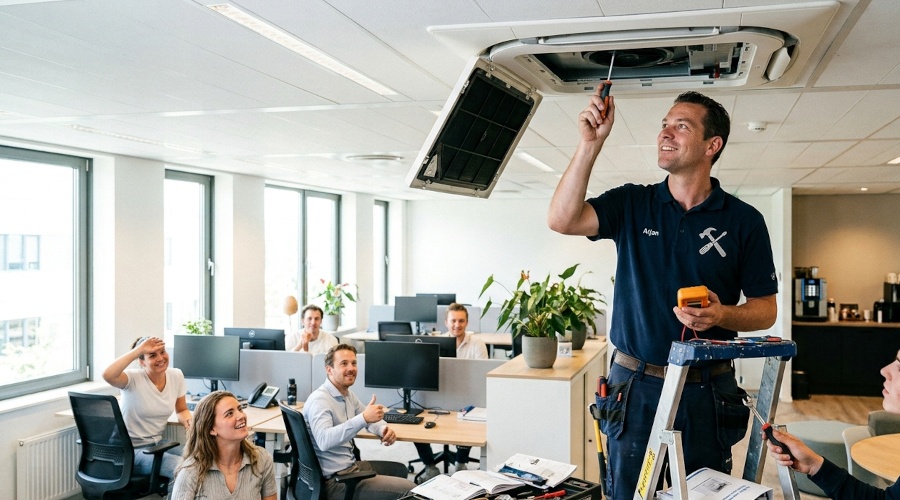
You arrive at the office on a hot summer's day and the air conditioning has broken down. It's already thirty degrees inside within minutes. Who do you call, and what can you actually expect? And if the fault doesn't get fixed, what rights do you have as a tenant under Dutch law? That last question is one most tenants only ask once it's already too late, when you could just as easily have the answer ready beforehand. Later in this article, we'll walk you through the escalation ladder, from a good conversation through to the legal steps Dutch law provides.
Renting an office is, at its core, a kind of partnership. You and the landlord or operator want the same thing: a pleasant, productive working environment where you can get on with running your business undisturbed. That partnership only really works well when both sides know upfront who's responsible for what, and that differs quite a bit between a traditional lease and a flexible workspace. Managing those expectations, before you sign, is exactly where we make the difference as your broker: we make sure the agreements on responsibilities, maintenance and malfunctions are clearly set out in writing from the start of your lease, not on the day the air conditioning finally gives out.
With a traditional lease, you're dealing with two parties: you as the tenant, and the landlord, usually the building owner or an investor. The landlord is responsible for the building's structure, the roof, the lifts, and the main installations, such as the central climate system. As the tenant, you're responsible for leaving the space in good order, preventing damage caused by your own actions, and, usually, small repairs within your own square metres, such as a broken lightbulb. There's no operator in this setup; you deal directly with the landlord.
With a flexible office or coworking space, a third party is added: the operator. They sit as a service layer between the building owner and you, and handle day-to-day matters such as wifi, the community environment, the coffee machines and cleaning. The installation that's broken is often still technically "the owner's", but the operator is your single point of contact. You don't need to work out who's responsible for what yourself, the operator handles that behind the scenes.
This distinction is also what determines which steps you can take further down this article if a fault drags on too long, so it's worth being clear on which situation applies to you.
When something breaks, say the air conditioning or the internet goes down, swift action is expected. But what's realistic, in each situation?
Duty to report. As a tenant, you're required to report a defect immediately. Do this through the official channel, such as a ticket or an email. At a flex office, if it's urgent, you'd also go straight to the community manager, which, back to our hot office day, is exactly who you'd need for that broken air conditioning too. With a traditional lease, you report a defect directly to the landlord or their managing agent.
The reality of the market. "Dealt with straight away" means the landlord or operator takes the report seriously immediately, gets an engineer on it, and keeps you updated. Unfortunately, it doesn't always mean an engineer on site within the hour. Tight labour markets or parts lead times can sometimes delay a permanent fix.
Creative interim solutions. This is exactly where you can tell a good landlord or operator apart. Rather than simply waiting, you work out together what's possible right now. Can portable cooling units be brought in temporarily? Can you shift temporarily to a space on the shaded side of a flex office? That way, the air conditioning on our hot day stays an inconvenience rather than a showstopper.
Dutch law naturally includes mechanisms to protect tenants if genuinely nothing happens. It's worth understanding how these work in practice, though, so you don't unnecessarily put the relationship on edge. Think of it as an escalation ladder. Note: the statutory steps below (step 3) are written for a formal lease agreement (huurovereenkomst) under Dutch law. With many flex and coworking contracts, which are often legally structured as a membership or service agreement rather than automatically qualifying as a lease under Dutch law, escalation in practice runs primarily through the SLA rather than these specific tenancy-law provisions. Unsure whether your contract qualifies as a lease? That's sometimes a genuine point of discussion even among lawyers, so don't hesitate to ask your landlord or operator directly.
Step 1: open communication, from both sides. As long as the landlord or operator communicates transparently about the timeline and works with you on temporary solutions, you'll generally sort it out together. This step works both ways, though. Report a defect fully and promptly, be specific about the impact on your business, and actively help think through interim solutions rather than simply waiting for a response. A landlord or operator who understands what's genuinely at stake for you can act better and faster too. This staged, dialogue-first approach, working things out together before anything becomes formal, is standard business practice in the Netherlands, and it's by far the most common and fastest route, and by far the most important one to get right yourself before escalating further.
Step 2: commercial discussion. If a fault unfortunately drags on longer, have a constructive conversation about a suitable, temporary form of compensation. Think of a temporary reduction in service charges, or free use of additional meeting rooms.
Step 3: the legal back door, the last resort. Should a landlord under a traditional lease structurally refuse to communicate or take action, Dutch law offers a number of instruments.
The first instrument is the ingebrekestelling (formal notice of default): a written notice giving the landlord one final, reasonable deadline to remedy the defect. Only once that deadline passes unused is the landlord formally in default (verzuim).
If repairs still don't follow, two further routes become available. Dutch law allows you to bring a claim for rent reduction (huurvermindering), proportionate to the loss of enjoyment of the property. Importantly, this isn't something you can simply decide yourself. You can't unilaterally lower the rent; the reduction has to be claimed through the courts. In addition, under certain conditions, you may be able to have a defect remedied yourself and deduct the reasonable costs from the rent. Those conditions are fairly strict: this is only possible after a formal notice of default and once the landlord is genuinely in default, and if you're unsure, or the repair is a costly one, it's sensible to get legal advice first before calling in a contractor yourself.
An important nuance for tenants. In almost all professional lease agreements, such as the standard ROZ model contracts (the Dutch Real Estate Council's widely used standard lease templates), the right to simply withhold or reduce rent independently is contractually excluded. Never do this on your own initiative, as it immediately puts you at a legal disadvantage due to a payment arrears. Treat legal steps as a genuine last resort, for when the conversation has completely broken down.
Please note: Flexas.com is an independent broker and advisor for finding office space. We cannot provide legal assistance in ongoing disputes with your current landlord or operator. If you're genuinely stuck, contact a real estate lawyer or your legal expenses insurer. This article describes the escalation route and legal instruments available under Dutch law specifically; other jurisdictions have their own mechanisms for handling unresolved defects (such as rent abatement or repair-and-deduct provisions), which work differently and under different conditions.
The demarcation list, for traditional leases. When signing a traditional lease, always check the demarcation list (demarcatielijst), usually an appendix based on the ROZ model. This sets out, item by item, who's responsible for which technical maintenance.
The SLA, for flexible office space. Renting through an operator? Then there's usually no demarcation list, but a Service Level Agreement instead. This sets out the response times they commit to for, say, an internet outage or a power cut, and with a flex contract, this document is usually your most important point of reference, more so than the tenancy-law provisions from step 3 above.
Getting this right before you sign. This is precisely the kind of detail that's easy to overlook when you're focused on rent and location, and hard to renegotiate once you've already moved in. As part of our tenant representation, we review the demarcation list or SLA with you before you sign, so you know exactly who's responsible for what, and how quickly you can expect a response if something breaks, before it becomes a problem rather than after.
A good workspace is a shared responsibility. By knowing in advance who's responsible for what, understanding exactly which situation applies to you, communicating clearly when problems arise, and working together on practical interim solutions, the office stays a pleasant place to work for everyone.
Planning a new office? We make sure you have the right terms and responsibilities clearly set out in writing from day one.