Bas
van 't Hoff
Commercial Real Estate Broker

Search for "hub and spoke office model" and you'll mostly find content from flex operators, virtual-office providers and workplace tech companies, all parties telling a logical, understandable story from their own position in the market. That's valuable input, but it's one perspective on a question that has several sides.
Flexas works with both landlords and tenants, so we have no stake in one particular version of the story. For this article, we've deliberately looked beyond real estate as well: labour market research, data from Statistics Netherlands (CBS), and academic work on hybrid working. What follows is a look specifically at the Dutch office market, where the hub-and-spoke model runs into a genuinely unusual home-working culture, and where, done properly, it can still work well.
By international standards, the Netherlands is a clear leader in working from home. In 2023, 52% of all working people in the Netherlands worked from home sometimes or mostly, a higher share than in any other EU member state. And this isn't a lingering pandemic effect: in 2025, 81% of companies offered the option to work remotely, and more than 60% of employees actually made use of it in practice, figures that have barely changed since 2022.
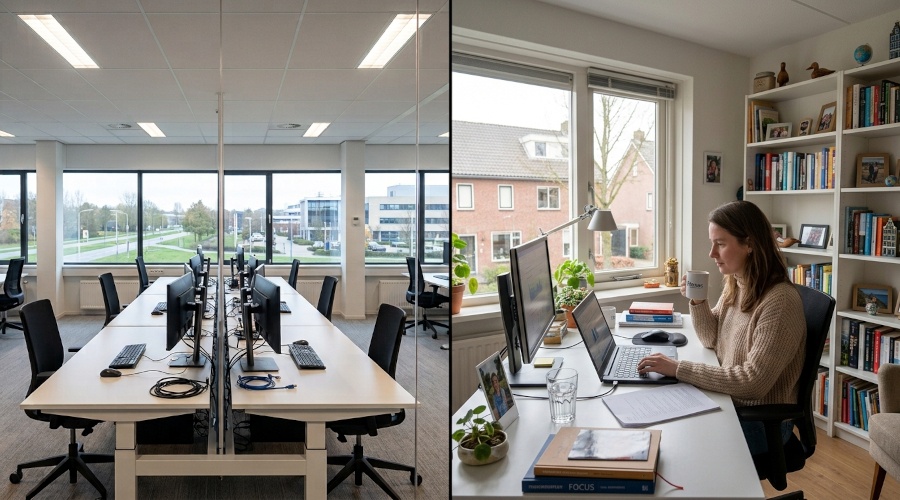
That's exactly where a traditional, fixed satellite office runs into trouble. It isn't competing with "no alternative", as might be the case in countries with gruelling commutes or less developed home-working infrastructure, but with a home workspace that the average Dutch knowledge worker has spent years building up, complete with equipment and routines. When the choice is between a quiet office floor on a regional business park and their own home office, the outcome is rarely a surprise.
Worth being precise about: as far as we know, no hard figure exists for a "vacancy rate for satellite offices". This is therefore a reasoned inference from the home-working figures, not a direct measurement. What is certain is that any long-lease satellite office that stays structurally underused represents a real financial risk, and that's exactly what businesses need to manage when designing a spoke strategy.
There's a second problem that has less to do with square metres and more to do with careers. Employees who work almost exclusively from a regional spoke, while leadership and the key decision-makers sit at the hub, run the risk of what has become known as proximity bias in hybrid work: unconsciously favouring colleagues you see in person more often.
This isn't a new phenomenon. A widely cited study by Stanford economist Nicholas Bloom, conducted among Chinese call-centre staff, found that home workers were 13% more productive, yet were promoted less often than their office-based colleagues. That's precisely the mechanism behind the criticism of hub-and-spoke: physical distance from where decisions are made translates into fewer opportunities, regardless of performance.
The story doesn't end there. Bloom repeated the study years later, this time at ten times the scale and among software engineers rather than call-centre staff, and this time there was no significant difference in promotion rates between office and home workers. Proximity bias, then, isn't a fixed law, it's a symptom of how an organisation measures performance and organises visibility. That's confirmed by more recent, peer-reviewed research among almost a thousand British managers: as soon as managers had access to concrete performance data on a home-working employee, the promotion gap all but disappeared. Without that data, the bias persists; with it, it largely disappears.
For a spoke-based employee who rarely visits the hub, that's a directly practical point. The further from the hub, the more essential it becomes that work and results are recorded objectively and visibly, rather than relying on the informal visibility office-based colleagues get automatically.
To keep the picture balanced: the model works excellently in other contexts, and understanding exactly why explains why it tends to struggle in Dutch office practice. In aviation and logistics, the model exists thanks to economies of scale over long distances, where consolidating at one central point lowers the cost per unit. In healthcare, it's used to centralise scarce, expensive expertise while keeping routine care close to the patient: a study of sleep care in remote parts of Australia found that 89.4% of patients could avoid a trip to the main hospital entirely thanks to a hub-and-spoke setup, with significant cost savings as a result.
What these successful applications have in common is a clear, functional reason to centralise something (specialist expertise, expensive equipment, economies of scale), combined with a genuine lack of alternative at the spoke location. For a Dutch office built around knowledge work, that second element is often exactly what's missing: the alternative, a home workspace, already exists and works well enough.
So the problem isn't the idea of a spoke itself, but the assumption that a spoke has to be a long-lease, fixed piece of real estate. That's a property decision made on the basis of expected occupancy, when in practice that occupancy tends to be erratic and often low.
Forward-thinking corporates are therefore increasingly opting for an on-demand model: flexible workspace subscriptions or credits with nationwide flex operators, rather than a dedicated lease per region. This approach solves two problems at once. The financial risk of vacancy disappears, because you only pay for actual use. And it makes presence measurable: a booking system shows exactly who's working where and how often, which in turn helps counter the proximity bias from section 2 with hard data rather than gut feeling.
While the central hub is often located in a prime spot for office space in Amsterdam, the flexible spokes can just as easily be set up in cities such as Rotterdam, Utrecht, The Hague, or the surrounding regions, without the organisation committing to space that may well sit empty. For most larger companies, that's the core of a workable office strategy: not less decentralisation, but less rigidity. The part that's genuinely hard to get right from the outside is matching this to the specifics of the Dutch market: which spoke locations actually get used, what an appropriate credit or subscription volume looks like, and how to structure it so the model doesn't quietly turn back into a fixed-cost liability.
This is exactly where Tenant Representation comes in. Rather than searching city by city and negotiating each lease separately, we act as your advisor across the full hub-and-spoke strategy: assessing which locations genuinely fit how your Dutch team works, negotiating terms with landlords and flex operators on your behalf, and building in the flexibility to scale spokes up or down as actual usage data comes in. We work with landlords and operators across the country, not just in Amsterdam, which means the advice reflects the whole Dutch office market rather than a single provider's offering. The aim is a hub-and-spoke setup shaped by how people in the Netherlands actually work, not by assumptions carried over from a different market.
Ask about our Tenant Representation for corporate teams.
Want to know what a hub-and-spoke strategy would look like for your organisation, without the risks of vacancy and proximity bias? Get tailored location advice for a centralised, activity-based hub, backed by our knowledge of the Dutch office market.
Leave an enquiry Rent office space with Flexas